
The Multi-Light, Multi-Light PLUS, Auto-Light, and High-Light workstations support several laser marking methods. Choosing the right on depends on the material, the visual/functional goal, and your process constraints (cycle time, depth, readability).
Engraving
Material removal to create a permanent recess.
Best for: Metals (steel, stainless steel, aluminum), some hard plastics.
Result: Matte, tactile mark with depth; excellent durability.
Notes:
- Depth increases with higher energy and/or multiple passes.
- Use fills (hatching) rather than outlines for solid areas.
- Manage heat to avoid warping thin parts (optimize speed, spacing, repetitions).
Annealing
Oxide-layer color change on steel/stainless steel without material removal.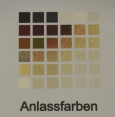
Best for: Stainless steel, some alloy steels.
Results: Dark (often black to brown) high-contrast mark; no tactile depth.
Notes:
- Keep energy density moderate; the mark comes from controlled heating, not ablation.
- Great for applications where surface integrity must remain untouched. (e.g., medical).
Carbonizing
Local heating on certain plastics creating carbonized dark marks.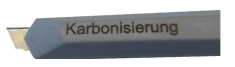 Best for: Light plastics where high contrast is needed.
Results: Darkened characters/graphics with good readability
Notes:
- Avoid excessive heat - can cause melt, bulge, or halo.
- Typically lower speed + controlled power to "bloom" contrast without charring.
Foaming
Heat induces gas bubbles under the plastic surface, creating a raised, lighter mark.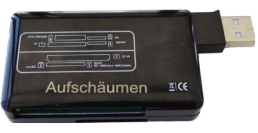
Best for: Dark plastics where light marks are desired.
Results: Light, slightly raised mark; good for UI panels, housings.
Notes:
- Tune energy so bubbles form uniformly - over-energy can collapse structure.
- Usually faster speeds with moderate power work well.
Layer Removal
Selective ablation of top coatings (paint, anodizing, powder coat) to reveal the base.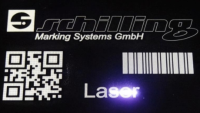 Best for: Anodized aluminum, painted/coated metals, laminates.
Results: High-contrast graphics/logos with crisp edges; fast cycles on thin coatings.
Notes:
- Use just enough energy to remove the coating only.
- Fine hatching and one or two passes often suffice; avoid attacking the substrate.
Foil Marking
Marking through or onto films/foils (e.g., label stock, laminates).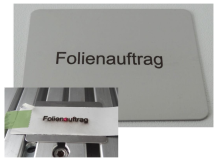
Best for: Decorative or functional labels; layered materials.
Results: Clean symbols/text; can combine with kiss-cutting depending on stack-up.
Notes:
- Verify foil behavior (melt/edge quality); adjust speed and hatch for clean edges.
- Ensure reliable extraction - thin films can produce sticky aerosols.
Choosing a Method - Quick Guidance
| Goal/Material | Recommended method(s) |
|---|---|
| Deep, durable on metal | Engraving (multi-pass fill) |
| High contrast on stainless, removal | Annealing |
| Dark text on light plastic | Carbonizing |
| Light text on dark plastic | Foaming |
| Logo on anodized aluminum/paint | Layer Removal |
| Labels/multilayer foils | Foil Marking |
Method Applicability
| Marking method | Multi-Light | Multi-Light PLUS | Auto-Light | High-Light | Important difference |
|---|---|---|---|---|---|
| Engraving | Supported | Supported | Supported | Supported | Achievable depth and heat input depend on power, pulse behavior, lens, and laser source. High-Light UV and UKP results must be qualified separately from fiber engraving. |
| Annealing | Supported on suitable steel and titanium | Same process | Same process | Source-depended | MOPA pulse control can provide more adjustment of color and heat input. Do not assume fiber parameter will work with UV and UKP sources |
| Carbonization | Supported on compatible light plastics | Same process | Same process | Source-depended | |
| Foaming | Supported on compatible dark plastics | Same process | Same process | Source-depended | |
| Layer removal | Supported | Same process with greater workpiece capacity | Same process in the integrated host machine | Source-depended | |
| Foil application | Supported | Supported | Supported | Supported with a suitable source | |
| Ablation foil marking and cutting | Accessory-depended | Accessory-depended | Accessory-depended | Accessory-depended |
Good Practices Across All Methods
- Focus first: Z-axis focus is the single biggest quality lever.
- Start conservative: Prove the look with lower energy, then optimize cycle time.
- Use fills wisely: Hatch angle and line spacing control contrast, smoothness, and time.
- Control heat: Balance power, speed, repetitions to avoid discoloration, melt, or halos.
- Extract fumes: Protect optics and improve consistency - especially for plastics and coatings.
- Parameter presets: Save verified parameter sets per material/finish for easy reuse.
Summary
Both Multi-Light and Multi-Light PLUS can produce deep engravings, oxide-layer anneals, carbonized or foamed plastic marks, clean coating removals, and foil marks. Match the method to the material and end-use requirement, dial in parameters methodically, and rely on extraction and focus discipline for consistent, high-quality results.