
Description: Learn how to maintain the Auto-Light optics, cooling airflow, filters and extraction systems to preserve safe operation and consistent marking quality.
Responsibilities and Original Parts
- Use original spare parts and approved consumables. Incompatible parts can impair safety and equipment reliability.
- Do not remove, bypass, or modify safety-related components, the shutter, the laser head, or protective covers.
- Reinstall every cover, connection, warning label, and safety device before returning the integrated machine to service.
- Do not use flammable or explosive cleaning agents in the processing area.
Daily Visual Check
- Inspect the lens and objective protective glass; clean only when necessary.
- Check the laser head, fibre routing, connectors, and rack for visible damage.
- Confirm that warning and identification labels are present and legible.
- Keep the work area clean and verify that process-fume extraction is available.
- Ensure the front and rear cooling openings are unobstructed.
Airflow, Filters, and Work Environment
The Auto-Light is air-cooled. Filter mats protect the rack electronics from dust and contamination. Blocked openings or contaminated filter mats cause heat accumulation and can damage the system.
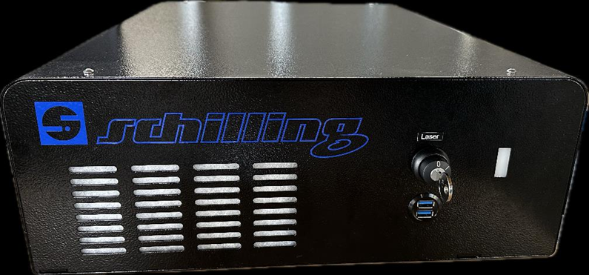
Auto-Light rack front. Keep approximately 15 cm clear at the cooling openings.
- Inspect the filter mats behind the front and rear ventilation openings and replace them when contaminated.
- Keep the surrounding area clean to reduce dust entering the cooling system and settling on optics.
- Operate suitable extraction whenever marking produces gases, vapors, aerosols, or dust.
Cleaning Optical Components
Laser optics are easily damaged. Prevent contamination through effective extraction and a clean work area. Never touch optical surfaces with bare fingers.
- Isolate the system and prepare a clean work area.
- Remove loose dust with a small clean hand blower. Do not use workshop compressed air because it can contain oil or water.
- Apply a small quantity of approved cleaning solution to a soft, lint-free optical tissue. Do not dip the tissue into the solution container.
- Wipe gently in a circular motion from the centre toward the edge. Keep the tissue moving and do not apply pressure.
- Do not use tools or hard objects. Scratches cannot be repaired.
- If contamination cannot be removed safely, stop and contact service
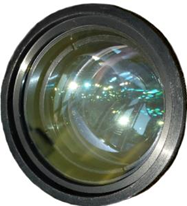
Example F-Theta lens. Handle optical surfaces only with approved methods and materials.
Suggested Maintenance Intervals
| Interval | Item | Method |
|---|---|---|
| Daily | Lens | Inspect and clean if necessary. |
| Monthly | Objective protective glass | Wipe carefully with a soft cloth and approved optical-cleaning agent. The source mentions acetone or diethyl ether; follow the chemical safety data and site rules. |
| Monthly | Fan and ventilation area | Wipe carefully with a dry cloth. Replace heavily contaminated filter mats. |
| Monthly | Extraction pre-filter, if fitted | Inspect and replace when full. |
| Monthly | Extraction main filter, if fitted | Inspect and replace when contaminated; shorten the interval for high process loads. |
Avoiding Faults - Typical Causes and Remedies
| Observation | Maintenance response |
| Weak or inconsistent marking | Verify focus first; inspect the objective and protective glass for contamination; confirm the approved parameter set. |
| Thermal alarm or unstable operation | Check that cooling openings are clear, clean the ventilation area, inspect filter mats, and verify ambient conditions. |
| Deposits around the process area | Check extraction airflow and filter condition; clean surrounding surfaces and review the qualified process. |
| Visible optical damage | Stop operation. Do not attempt to polish scratches or continue with a cracked protective glass; contact service. |
After Maintenance - Return to Service
- Confirm all covers, connectors, safeguards, and labels are installed and secure.
- Remove tools, tissues, solvents, and loose objects from the marking area.
- Restore power and verify the complete host-machine safety sequence, including emergency stop and shutter interlocks.
- Confirm cooling airflow and extraction operation.
- Perform a pilot-positioning check and a short test mark on an approved sample.